How Erectile Dysfunction Impacts Relationships — and Why Nobody's Talking About It
The silence around ED does more damage than the condition itself. Here's what's really happening in couples navigating this — and how to find your way back to each other.
Erectile Dysfunction Impacts Relationships
I'm going to tell you something I don't talk about lightly.
My husband and I have lived with erectile dysfunction. He has given me permission to share this because he has worked through the shame this diagnosis carries — and because we both believe that someone else's shame shouldn't keep you from getting information that could change your relationship.
I'm a therapist who specializes in helping couples navigate ED. My PhD dissertation was literally on erectile dysfunction. I have sat with hundreds of couples in my office and walked them through exactly this territory.
But I'm not writing this from a comfortable clinical distance. I know how erectile dysfunction impacts relationships because I've been inside one. The disappointment. The conversations that felt impossible to start. The slow, quiet distance that creeps in when two people stop reaching for each other.
I'm fortunate that my training helped us navigate it. We've built a closer, more honest intimate life because of how we chose to deal with it. But it has not been easy. And it wouldn't have been possible if we hadn't broken the silence.
The Silence Around Erectile Dysfunction Is the Real Problem
Erectile dysfunction is one of the most common issues affecting couples in midlife. And almost nobody talks about it.
Not at dinner parties. Not with close friends. Not even, sometimes, with a doctor.
Men who experience ED often carry enormous shame, partly because our culture has built an impossible image of what a "real man" is. Nobody sits at a bar with friends and says, "Hey, I've been having trouble getting hard. Anyone else?" The thought is almost absurd, which tells you everything about how little space we've created for this conversation.
Women aren't much better at it, honestly. Even among close girlfriends who share almost everything, this topic tends to stay locked up. There's an unspoken pact of secrecy that surrounds it.
And on top of that, people make insensitive jokes about ED that reinforce toxic stereotypes and make addressing it even harder than it already is.
The silence does damage. Not because ED itself has to be a relationship-ender, but because the stories couples make up in the absence of real conversation almost always are.
How Common Is Erectile Dysfunction? The Numbers Will Surprise You.
Approximately 30 million men in the United States experience erectile dysfunction. Worldwide, that number is estimated at 326 million.
Let that actually sink in.
By age 40, roughly 40% of men have experienced some degree of ED. By age 70, that number climbs to around 70%. And those are only the men willing to report it.
ED is fundamentally a midlife health issue. It can be caused by physical factors — cardiovascular disease, diabetes, high blood pressure, hormonal changes, prostate cancer, and the natural effects of aging on vascular and neurological function. It can also be driven or significantly worsened by psychological factors: anxiety, depression, stress, performance pressure, and relationship tension. Often it's both, layered together in ways that take real patience to untangle.
And despite what pharmaceutical companies promise you about the little blue pill, it doesn't work for approximately 30% of men who take it and carries real side effects. There is no automatic fix. This is not a problem you can just medicate away. You can read more about it in my blog post Why Pills Don’t Fix Erectile Dysfunction for Everyone.
This is not a rare or niche condition. This is a midlife reality that millions of couples are navigating in complete isolation, each one silently assuming they're the only ones.
How Erectile Dysfunction Really Impacts Relationships: The Part Nobody Talks About
When a man begins experiencing ED, something else almost always happens alongside it.
He starts pulling away. Not just from sex. From all touch. From closeness. From the casual physical language of a relationship: his hand on your lower back, lazy Sunday morning cuddles, a kiss that lingers a little longer than a goodbye. He stops initiating things that used to lead somewhere — romantic dinners, going to bed at the same time, the kind of closeness that used to feel easy.
He does this because touch has become loaded. Physical closeness now carries the weight of potential failure, and it's easier to avoid all of it than to risk that sinking moment of disappointment again — his own, and yours.
He may not even realize he's doing it.
But you feel it. And it really hurts.
You reach for him and something in him stiffens in a way that means not right now, not tonight, please don't. And over time, you stop reaching. Because rejection — even unintentional rejection — has a cumulative effect on a person's willingness to be vulnerable. So you protect yourself.
This is how ED quietly erodes a relationship. Not in one dramatic moment. In a thousand small withdrawals.
The Stories Partners Tell Themselves When There's No Conversation
In the absence of honest conversation, partners fill in the blanks. And the stories are almost never kind ones.
He doesn't find me attractive anymore. He's not interested in me. He's getting it somewhere else. Something is wrong with me. Maybe this is just what happens when love fades.
None of those stories are likely to be true. But they feel true. And they shape behavior. You pull back too. You stop initiating. You stop flirting. You tell yourself you're being respectful of his struggle when really you're protecting yourself from feeling unwanted.
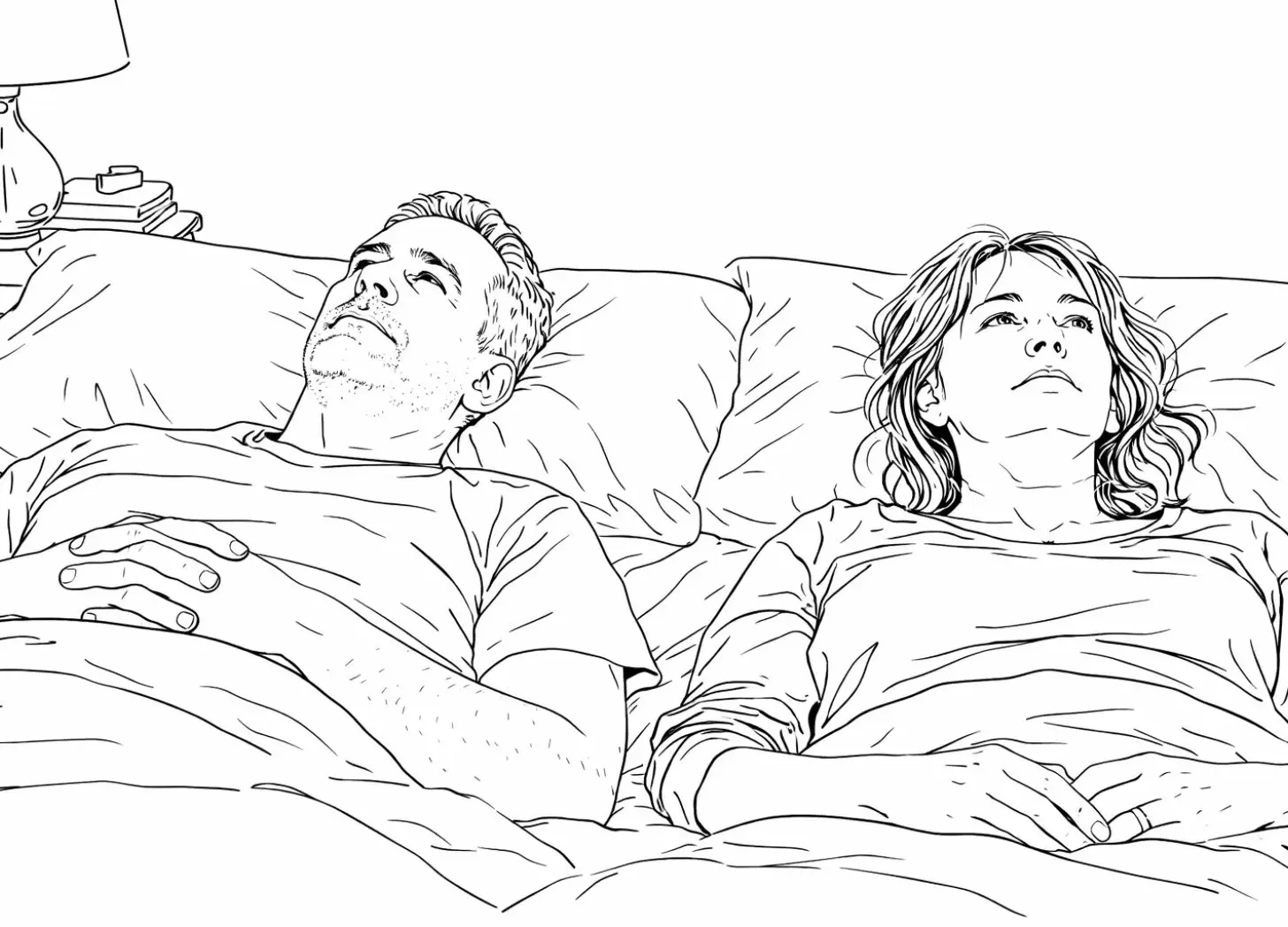
And now two people who love each other are sleeping in the same bed six inches apart, each one silently convinced the other has checked out. You become roommates instead of lovers.
That's the real crisis. Not the ED itself. The isolation it creates. The loneliness. The quiet grief of feeling undesired by the person you love most.
Performance Anxiety: The Biggest Contributor to Erectile Dysfunction That Nobody Addresses
Here's something important that gets overlooked in most conversations about ED: performance anxiety is one of the single biggest contributors to erectile dysfunction across all age groups and all causes.
Even when ED starts as a physical issue, the anxiety that grows around it almost always makes it worse. A man has one difficult experience and suddenly every sexual encounter is loaded with fear. He's watching himself instead of being present. He's anticipating failure instead of experiencing connection.
That anxiety creates a cycle that can feel nearly impossible to break without the right tools and support. It's not weakness. It's a predictable psychological response to a genuinely frightening experience.
Understanding performance anxiety — and knowing how to work through it — is one of the most important things a person with ED, and their partner, can do.
How Erectile Dysfunction Doesn't Have to Define Your Relationship
I want to be careful not to make this sound simpler than it is. My husband and I have had hard conversations. Awkward ones. Conversations that didn't land well the first time and needed a second attempt. We've had to grieve some things and creatively reimagine others. We've gotten curious about intimacy in ways that felt unfamiliar and sometimes uncomfortable.
I won't sugarcoat it. If I could rewrite our story, ED wouldn't be in it. But it is in our story. And the most important thing has been how we chose to deal with it.
We're closer for it. Not despite navigating this, but genuinely because of it. Because we chose conversation over silence. Curiosity over avoidance. Each other over our own private shame.
What Couples Who Navigate Erectile Dysfunction Successfully Have in Common
They keep talking about it. Not once, in a single painful conversation, but as an ongoing dialogue that gets less loaded with practice.
They separate ED from desirability. They work hard to disentangle the mechanics of erectile function from the question of attraction, love, and wanting each other.
They expand their definition of intimacy. Sex is not one thing. Physical closeness is not one thing. Couples who navigate ED well tend to become genuinely more creative and more connected in how they experience each other. That's not a consolation prize. That's a real gift, if you're willing to stay curious.
They get support. A therapist, a workshop, a community of people who actually understand what this is like. Trying to figure this out in a vacuum, without any roadmap, is unnecessarily hard and too often ends in both people shutting down completely.
For the Women Reading This: Your Experience Matters Too
I see you.
You're probably the one who found this article. You're the one who has been quietly carrying the emotional weight of this — wondering how to bring it up, afraid to hurt his feelings, second-guessing your own feelings, trying to be understanding while also being human enough to feel the loss of something you didn't expect to lose.
The grief. The frustration. The longing. The confusion. The quiet suspicion that somehow you're not sexy enough for him to get hard — even though that's almost certainly not what's happening. All of it is valid. All of it makes sense.
And you deserve support that's specifically for you. Not just for the couple. Not just for him. For you.
Ready to Stop Navigating This Alone?
On February 19th, I'm hosting a live virtual workshop called When Intimacy is Complicated by Erectile Dysfunction, designed specifically for women who are partners of people with ED.
We'll talk honestly about the emotional impact, the relational patterns, how to have the conversations that feel impossible, and how to begin rebuilding intimacy in ways that actually work.
Find all the details and register here: lovefilledlife.com/erectile-dysfunction-emotional-impact-women
And if you're the one experiencing ED and looking for somewhere to start right now, I have a pre-recorded self-paced training called Mastering Performance Anxiety that addresses one of the biggest drivers of ED across the board.
You can access it anytime here: lovefilledlife.com/Overcome-Performance-Anxiety-workshop
One More Thing
There's a version of this story that ends in quiet disconnection and roommate status. I've watched it walk into my therapy office more times than I can count.
But there's another version. One where the thing that felt like it was breaking you open actually cracks open something more honest, more tender, and more real than what you had before.
That version is possible. I know because I'm living it.